
Directed by Rex Miller • Documentary • 2014 • 83 minutes
Althea Gibson broke records on and off the tennis court. A truant from the rough streets of Harlem, Gibson emerged as a most unlikely queen of the highly segregated tennis world in the 1950s. A sharecropper's daughter, Gibson's family migrate north to Harlem in the 1930s, when fame that thrust her into the glare of the early Civil Rights movement.
No player, not even the great Arthur Ashe (who came a decade after Gibson), overcame more obstacles to become a champion than Althea Gibson; the first African-American to play at-and win-Wimbledon and the US Open was a woman.
Gibson was celebrated by ticker-tape parades in New York City, twice, to welcome her home after hard-fought victories. But there was no professional tennis circuit for women in her era, so her options were limited. As Gibson said, 'You can't eat a crown.' When she became the #1 player in the world, she still could not afford her own apartment.
In Rex Miller's moving and thoroughly-researched documentary, this elite athlete is finally given the attention she so richly deserves as uncompromising and courageous trailblazer and American pioneer.
Up Next in African-American Docs
-
'63 Boycott
Directed by Gordon Quinn • Documentary • 2017 • 30 minutes
On October 22, 1963, more than 250,000 students boycotted the Chicago Public Schools to protest racial segregation. Many marched through the city calling for the resignation of School Superintendent Benjamin Willis, who placed trailers, ...
-
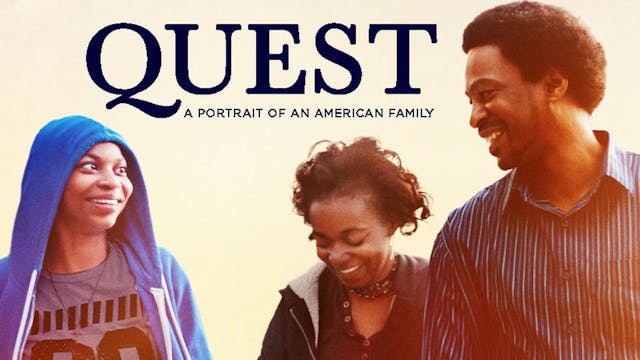
Quest
Directed by Jonathan Olshefski • Documentary • 2017 • 105 minutes
Filmed with vérité intimacy for nearly a decade, Quest is the moving portrait of the Rainey family living in North Philadelphia.
Beginning at the dawn of the Obama presidency, Christopher “Quest” Rainey and his wife Christine’a ...
-
Black Is the Color: A History of Afri...
Directed by Jacques Goldstein • Documentary • 2017 • 52 minutes
In 1969, the Metropolitan Museum of Art in New York mounted a major exhibit called “Harlem On My Mind.” There was just one thing wrong: the show had no work by African-American artists.
The “Harlem on My Mind” fiasco is emblematic ...